Archiv - Musical
Martin Bruny am Samstag, den
3. Dezember 2011 um 05:13 · gespeichert in Musical, Wien, Theater, Event-Tipps
| 18. Dezember 2011 |
| 19:00 | bis | 20:30 |
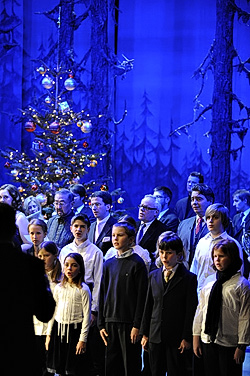 Die Volksoper Wien bietet seit Jahren in der Adventszeit stimmungsvolle Konzerte. 2011 sind bei der großen Weihnachtsshow Publikumslieblinge wie Sandra Pires, Sigrid Hauser, Birgid Steinberger, Elisabeth Flechl, Adrineh Simonian, Sà¡ndor Nà©meth, Sebastian Reinthaller, Christoph Wagner-Trenkwitz und viele andere mit dabei. Es spielt das Orchester der Volksoper, es singen der Chor der Volksoper Wien sowie der Kinderchor der Volksoper Wien und es tanzt das Wiener Staatsballett.
Am 18. Dezember geht das »große Weihnachtskonzert 2011″ über die Bühne, einmal um 14 Uhr und am selben Tag um 19 Uhr. Geboten wird eine Mischung aus modernen Weihnachtssongs, klassischen internationalen Weihnachtsliedern und einiges mehr.
Am Programm unter anderem:
- »Arabischer Tanz« aus dem »Nussknacker« (Tschaikowsky): Wiener Staatsballett
- »Russischer Tanz” aus dem »Nussknacker« (Tschaikowsky): Wiener Staatsballett
- »The Little Drummer Boy” (Katherine Kennicott Davis): Sà¡ndor Nà©meth
- »Carol of the Bells” (trad.): Kinderchor der Wiener Volksoper
- »Mrs. Santa Claus” (Nat King Cole): Sandra Pires, Kinderchor der Wiener Volksoper
- »The Twelve Days of Christmas« (Frederic Austin): Sandra Pires, Kinderchor
- »Abendsegen« und »Engelreigen« aus »Hänsel und Gretel” (Engelbert Humperdinck): Birgid Steinberger, Adrineh Simonian
- »Miss You Most At Christmas Time« (Mariah Carey): Sandra Pires
- »O Holy Night” (Adolphe Adam): Otoniel Gonzaga, Kinderchor
- »Candide – Finale« (Leonard Bernstein)
- »Adeste Fidele« (John Francis Wade)
Besetzung
Elisabeth Flechl, Sigrid Hauser, Martina Mikelic, Sandra Pires, Melba Ramos, Adrineh Simonian, Birgid Steinberger; Otoniel Gonzaga, Sebastian Holecek, Sà¡ndor Nà©meth, Sebastian Reinthaller, Christoph Wagner-Trenkwitz
Dirigent: Michael Tomaschek
Klavier: Eric Machanic
Choreinstudierung: Thomas Böttcher
Kinderchoreinstudierung: Lucio Golino
Moderation: Helene Sommer
Nähere Infos & Tickets für die beiden Shows gibt es auf der Website der Volksoper Wien –> hier.
Martin Bruny am Freitag, den
2. Dezember 2011 um 12:51 · gespeichert in Musical, Wien
Natürlich, es gilt die Unschuldsvermutung, und wer weiß schon, ob er sich beworben hat … und überhaupt. Aber wie auch immer, wir lesen heute im »Standard«:
Mehr Logik erhält die Begründung hingegen angesichts eines Branchengerüchts, wonach der ORF-Moderator Haider als Nachfolger Zechners als Musicalchef bei den Vereinigten Bühnen kursiert. [Standard]
Martin Bruny am Donnerstag, den
1. Dezember 2011 um 10:22 · gespeichert in Listen, Awards
Am 12. Februar 2012 finden die 54. Grammy Awards statt, in der vergangenen Nacht wurden die Nominierungen für die begehrten Preise der National Academy of Recording Arts & Sciences verlautbart. Ein paar Nominierungen in den in etwa Musiktheater (& -Film)-relevanten Kategorien:
Best Musical Theater Album
01. Anything Goes - New Broadway Cast Recording [Ghostlight Records]
02. The Book of Mormon - Original Broadway Cast [Ghostlight Records]
03. How to succeed in Business without really trying - 2011 Broadway Cast Recording [Decca]
Best Compilation Soundtrack For Visual Media
01. Boardwalk Empire: Volume 1 - (Various Artists) [Elektra]
02. Burlesque - Christina Aguilera [RCA Records]
03. Glee: The Music, Volume 4 - (Glee Cast) [Columbia Records]
04. Tangled - (Various Artists) [Walt Disney Records]
05. True Blood: Volume 3 - (Various Artists) [WaterTower Music]
Best Song Written For Visual Media
01. Born to be somebody (aus “Never say Never”)
Diane Warren, songwriter (Justin Bieber) [Island/Raymond Braun/School Boy]
02. Christmastime is killing us (aus “Family Guy”)
Ron Jones, Seth MacFarlane & Danny Smith, songwriters (Danny Smith, Ron Jones & Seth MacFarlane)
[Fox Music]
03. I see the light (aus “Tangled”)
Alan Menken & Glenn Slater, songwriters (Mandy Moore & Zachary Levi) [Walt Disney Records; Publishers: Wonderland Music/Walt Disney Music]
04. So long (aus “Winnie the Pooh”)
Zooey Deschanel, songwriter (Zooey Deschanel & M. Ward) [Walt Disney Records; Publisher: Walt Disney Music]
05. Where The River Goes (aus “Footloose”)
Zac Brown, Wyatt Durrette, Drew Pearson & Anne Preven, songwriters (Zac Brown) [Atlantic/Warner Music Nashville; Publishers: Weimerhound Publishing,Warner-Tamerlane Publishing, CYP Two Publishing,
Lil Dub Music/Angelika Music]
06. You Haven’t seen the last of me (aus “Burlesque”)
Diane Warren, songwriter (Cher) [RCA Records; Publisher: Realsongs]
Best Pop Duo/Group Performance
01. Body and Soul: Tony Bennett & Amy Winehouse
Track from: Duets II [Columbia Records]
02. Dearest: The Black Keys
Track from: Rave On Buddy Holly [Fantasy]
03. Paradise: Coldplay
[Capitol Records]
04. Pumped up Kicks: Foster The People
Track from: Torches [Star Time Intl./Columbia]
05. Moves like Jagger: Maroon 5 & Christina Aguilera
Track from: Hands All Over [A&M/Octone Records]
Best Traditional Pop Vocal Album
01. Duets II: Tony Bennett & Various Artists - [Columbia Records]
02. The Gift: Susan Boyle - [Syco Music/Columbia Records]
03. In concert on Broadway: Harry Connick Jr. - [Columbia Records]
04. Music is better than words: Seth MacFarlane - [Universal Republic]
05. What matters most: Barbra Streisand - [Columbia Records]
Eine Liste aller Nominierungen gibt es –> hier zum Download.
Martin Bruny am Dienstag, den
29. November 2011 um 21:51 · gespeichert in Musical, Broadway
Die »New York Times« spekuliert in einem Artikel über die Chancen, dass die Broadway-Fassung des Musicals »Spider-Man« irgendwann einmal auch ihre Produktionskosten hereinspielen könnte. 75 Millionen Dollar wurden in die Show gesteckt, pro Woche kostet die Produktion eine weitere Million. Derzeit wirft “Spider-Man” einen Gewinn pro Woche von 100.000 bis 300.000 Dollar ab. Einfache Rechnung: Mindestens fünf Jahre muss sich das U2-Werk am Broadway halten, dann könnte es sich für die Produzenten rentieren. Bis dahin wird es keine Produktion in einem anderen Land geben. Eine Aussage der Produzenten dazu:
Before we mount ‘Spider-Man’ anywhere else, we want to make sure we have the strongest and most financially successful version in New York that we can get. The one thing about the brand of ‘Spider-Man,’ it’s not going to expire. If we show up in London five years from now, no one’s going to say it’s an old property.
Link
– The New York Times: Turn on the Cash: After a Year, ‘Spider-Man’ Earns Its Weekly Keep
Martin Bruny am Dienstag, den
29. November 2011 um 14:28 · gespeichert in Musical
Zum 80-jährigen Jubiläum der Seegrotte Hinterbrühl wird das Musical »Der Mann von La Mancha« von Dale Wasserman, Mitch Leigh und Joe Darion im Festsaal aufgeführt. Das unterirdische Ziegelgewölbe des Festsaals der Seegrotte wird zum Kerker der spanischen Inquisition. Die Regie hat Tamas Ferkay, der auch den Sancho Pansa spielt, übernommen, in der Hauptrolle ist Alfons Noventa zu sehen.
Das Schaubergwerk Seegrotte Hinterbrühl ist ein stillgelegtes Gipsbergwerk. Im Jahr 1912 flossen nach einer Sprengung mehr als 20 Millionen Liter Wasser in die Gänge und Stollen, so entstand der größte unterirdische See Europas. Im Jahre 1932 wurde die Seegrotte zum ersten Mal als Schaubergwerk eröffnet. Während des Zweiten Weltkriegs errichteten die deutschen Heinkel-Werke in den Gängen der Seegrotte eine große unterirdische Flugzeugfabrik, die 1945 zerstört wurde. Es dauerte drei Jahre, bis das Bergwerk renoviert war und für die Touristen wieder zugänglich wurde.
1993 war die Seegrotte Drehort für die Disney-Produktion »Die Drei Musketiere« mit Charlie Sheen, Kiefer Sutherland und Chris O’Donnell. Mehr als zehn Millionen Menschen haben das ehemalige Bergwerk bisher besucht, allein im Vorjahr kamen rund 250.000 Personen aus aller Welt.
Termine
20. Januar 2012 bis 3. März 2012 Jeweils Donnerstag bis Samstag
Beginn: 19.30 Uhr, Ende: ca. 21.00 Uhr keine Pause
Tickets
Kategorie A / B / C: € 49,–/ € 46,– / € 43,– (inkl. Gebühren)
Ermäßigung für Schüler, Studenten, Senioren: -10 %
Weihnachtsbonus: –5 % (nur bis 24.12.!)
Ermäßigung für Generalprobe und Vorpremiere: –30% (keine weiteren Ermäßigungen möglich)
Kartenvorverkauf ab 1. Dezember 2011
– oeticket, Tel.: 01/96 0 96, www.oeticket.com
– Tageskassa Seegrotte: Mo–So 9.00–15.00 Uhr, Tel.: 02236/263 64
– Abendkassa Seegrotte: an Spieltagen 1 Stunde vor Vorstellungsbeginn
Link
– Website der Seegrotte Hinterbrühl
Martin Bruny am Montag, den
28. November 2011 um 04:29 · gespeichert in Musical, Wien
Am 12. Dezember 2011 spielt Andreas Bieber seine Weihnachtsshow “Alle Jahre … Bieber” im Wiener Theater Akzent. Als Gäste mit dabei: Drew Sarich, Ann Mandrella und Carin Filipcic.
Zu hören sind Hits aus jenen Shows, in denen Andreas Bieber im Laufe seiner Karriere aufgetreten ist, Ausschnitte aus seinen Soloprogrammen “You walk with me” und “No Frontiers” – und Weihnachtslieder.
Überraschenderweise gibt es noch Tickets, wer also noch dabei sein will, kann –> hier bestellen.
Martin Bruny am Sonntag, den
27. November 2011 um 14:42 · gespeichert in Musical, Wien
Aufregung in der Chefetage der Vereinigten Bühnen Wien. Die Stadt Wien hat beschlossen, die Subventionen für die VBW um 750.000 Euro zu kürzen – eine Summe, die dem als »Gewinn« ausgewiesenen Betrag von 2010 entspricht.
Geschäftsführer Drozda:
»Das erinnert mich an die Steinzeitkameralistik, wo man im Dezember Druckerpatronen gekauft hat, um nicht das Budget im Jänner gekürzt zu bekommen. Es ist nicht sehr motivierend, auch wenn es wirtschaftlich harte Zeiten sind. Dass das weder bei uns noch unseren Sponsoren Begeisterungsstürme auslöst ist, ist sicher zutreffend beobachtet. Ich hätte es lieber den Rücklagen zugeführt.«
Hätten sich die VBW gemäß ihrem ursprünglichen Auftrag in den letzten Jahren darum gekümmert, neue, interessante und innovative »Musical«-Produktionen in Wien auf die Bühne zu bringen, könnte man bezüglich der 750.000 Euro als am Musicalgenre Interessierter vielleicht der Meinung sein, dass es schade ist, sie nicht mehr für derlei Projekte verwendet zu wissen. Tatsächlich aber wurde im deutschen Angebotsmarkt geshoppt und dann das Eingekaufte musikalisch hochpoliert – und Altes wurde aus der Mottenkiste geholt, was 2012, Stichwort »Elisabeth«, nicht anders werden wird. Und ja, auch die »Druckerpatronen« gibt es ja nach wie vor, nur heißen sie bei uns Kolonovits, Becker & Co.
Link
- orf.at: Kritik an Kürzung der Subventionen
PS: Optimalerweise sollte man die bei den VBW eingesparten 750.000 Euro ins Musicalgenre investieren und kleinere Projekte finanzieren, deren Initiatoren fördern und ermutigen, beispielsweise Rory Six und Dirk Schattner, die vor wenigen Tagen ihre neue Show »Das Mädchen mit den Schwefelhölzern« auf der Probebühne des Ronacher präsentiert haben.
Martin Bruny am Freitag, den
25. November 2011 um 03:15 · gespeichert in Musical
Ein paar Vorankündigungen zum Theatersommer 2012 gibt es bereits, und schon vorab, um den Wiener Zynikern die Schießfreudigkeit zu rauben, kommentieren oberösterreichische Medien die Auswahl der Stücke und der Regisseure. Man lehne sich beim Theatersommer 2012 nicht gerade aus dem Fenster, meinen die »Oberösterreichischen Nachrichten«.
In Amstetten spielt man das einzige Musical von Alan Menken, das tatsächlich zu einem Kultstück geworden ist und noch nicht der Fließbandvernotung entstammt: »Little Shop of Horrors”. Ob man nach einem Jahr Pause in Amstetten mit der x-ten Version des Stücks einen Publikumsrenner auf die Bühne bekommt, wird man sehen. Ramesh Nair soll als Marke den Erfolg garantieren.
Nach Steyr holt man sich 2012 den Regisseur, Filmemacher und Produzenten Hannes Rossacher. Nicht etwa für ein Falco- oder Queen-Musical, sondern »My Fair Lady« wird er inszenieren, eine Open-Air-Aufführung im Schlossgraben von Schoss Lamberg. Acht Vorstellungen werden gegeben, der Kartenvorverkauf startet am 1. Dezember 2011.
In Wien werde man zu all dem »Im Westen nichts Neues« sagen, meinen die »Oberösterreichischen Nachrichten«. Nunja, 2012 mit »Cats« und »Elisabeth« als größere Produktionen, wird man in Wien wohl andere Sorgen haben, als sich über den Theatersommer das Maul zu zerreißen.
Links
- Musikfestival Steyr
- Musicalssommer Amstetten
- Oberösterreichische Nachrichten: Nummer sicher
Martin Bruny am Donnerstag, den
24. November 2011 um 23:21 · gespeichert in Musical
In einem ausführlichen Interview, das Kenneth Jones von Playbill mit Stephen Sondheim führte, ging es unter anderem um Cast-CDs.
Playbill: What makes a good cast-album producer
Stephen Sondheim: Well, most of it has to do with efficiency. Unlike pop albums, you have one day — or with two records, two days — in which to record everything, so you can’t do the infinite amount of takes that pop recording artists are privileged to do. So a lot of it has to do with things like logistics, because, of course the unions, like Equity and the musicians’ union, have strict rules as to how many hours people can work. So you have to have an actor come in from 10 o’clock to 1 o’clock, go home and come back in at 4 o’clock, etc., etc., etc.
That’s one of the things that a producer has to do. And the other thing is to say whether the album is going to be just a collection or songs or whether it’s going to have some sort of arc to it. And then the other thing is, of course, to have taste and a good ear and be able to get the best out of the performers in a limited amount of time — and knowing what you can do in the editing room and what you can’t do in the editing room. It’s a skill like anything else and it comes mostly with experience.
Playbill: One of the changes in the world of cast albums in the past 25 years is that you can get 79 minutes on a disc — perhaps a complete score.
Stephen Sondheim: Yes sir, yes sir. In the old days, in the days of LPs, you had to do a lot of judicious cutting because if you crowded too much onto one side of a record then the equalization went off and the album suffered as a result. But if you didn’t, then you suddenly went 15 minutes over length and then what could you do except cut things down. The original cast album of Follies, on Capitol, is a perfect example of this. It’s a dreadful album because there simply wasn’t enough space for time and Capitol wouldn’t give us two records.
Playbill: And a generation grew up thinking that was the whole score…
Stephen Sondheim: Yeah, I know. Unfortunately. But, you know, these things get corrected, at length. It would be nice to have a full-length, proper recording with the original cast but we didn’t.
Zum Interview geht’s –> hier.
Martin Bruny am Donnerstag, den
24. November 2011 um 14:31 · gespeichert in Musical
In seinem Buch »Look, I Made a Hat« setzt sich Stephen Sondheim mit der Stellung des Kritikers im Kulturbetrieb auseinander – einer aus der Zunft der Kritiker, Michael Billington vom englischen »Guardian«, antwortet dem Komponisten und Texter und rechtfertigt die Existenz der Kritik folgendermaßen:
One is that art doesn’t exist in a social or economic vacuum. Many years ago, I was involved in a radio debate with the late Simon Gray who made some similar points to Sondheim. A dramatist with a new play, said Gray, was as vulnerable as a mother with a new baby. She wouldn’t like it if she took her baby to the park and people poked their noses into the pram and criticised the baby’s legs for being too short or its nose too long. Fine, I said. But, once you start charging people up to £50 a time for a glimpse of a new infant, you must expect public comment.
Secondly, I’m sure Sondheim must have been irked over the years by being told that his melodic gifts rarely match his lyrical inventiveness or by seeing a pioneering work such as Merrily We Roll Along written off while lesser musicals by other hands rake in the shekels. But I wonder how Sondheim would feel if any work on which he had laboured long and hard opened to a deafening silence. Artists often hate critics; they also need the stimulus of public comment. I met an actor friend recently who had undertaken a major role I had not been able to review. He was not angry or resentful but his disappointment was visible. And, in my experience as both a critic and occasional author, what we all crave is a reaction to our work.
Thirdly, I think Sondheim is writing about a very specific American – and New York – culture in which the dearth of newspapers gives critics a disproportionate authority. Thankfully, in Britain, we still have enough print outlets for critical power to be dispersed and artists to take a pick-n-mix approach to what they read. And although internet and showbiz chatrooms have democratised comment, as Sondheim rightly points out, I’m not sure whether the musical as a form has hugely benefited. I can think of at least two shows – Sweet Smell of Success in New York and Love Never Dies in London – that were hastily damned by bloggers even before they had formally opened.
But I’ve no wish to pick a quarrel with Sondheim, whose work I mostly revere. I just feel that his ideal of judgment by one’s peers, rather than us ill-informed hacks, is not one every artist would share. After all, who dubbed Noel Coward the Master of Blather and said that his lyrics come in two flavours: brittle and sentimental? “The brittle ones,” he went on, “are condescending, either implicitly or explicitly. The sentimental ones are florid, sometimes extending into unintentional camp.” Who was this acerbic critic? Why none other than the sainted Stephen himself.
Link
- guardian.co.uk: Who needs critics? Why you do, Mr Sondheim
« zurueck ·
vor »


